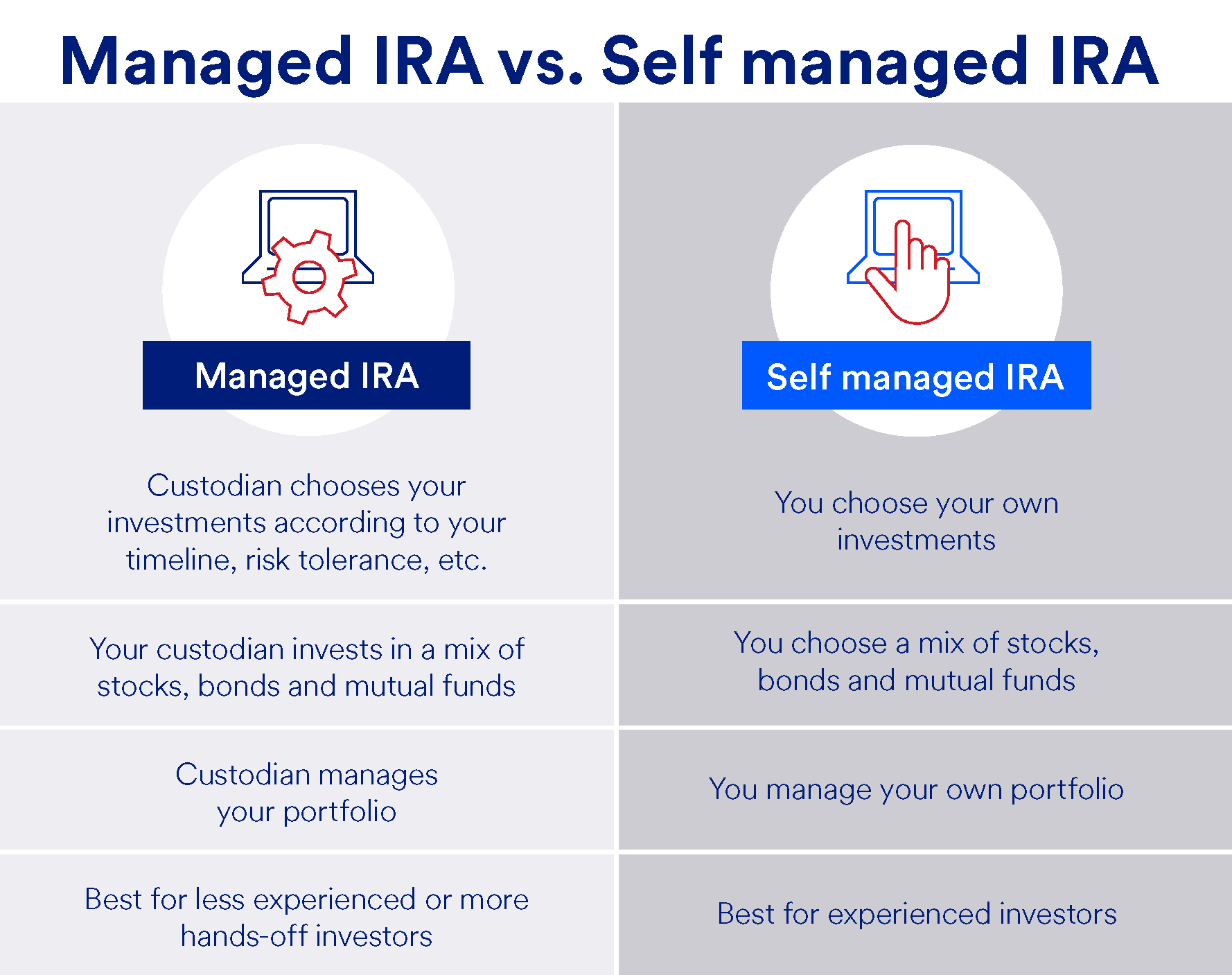
Are you someone who likes to research and educate yourself to accomplish tasks and projects? If so, managing your own individual retirement account (IRA) may be a good option to explore. A self-managed IRA allows you to choose your own investments from the myriad options provided within a custodial brokerage account.
Self-managing your IRA investments can be rewarding, but it also comes with risks and considerations that you need to carefully evaluate. As a result, this “DIY” IRA, and self-directed investing in general, may be more appropriate for seasoned investors, as it could be risky for someone who doesn’t understand the nuance of selecting appropriate investment options for their situation.
A note that if you’re interested in managing your own IRA, be sure to look closely at the account stipulations. Some self-directed IRAs allow you to invest in alternative investments such as commodities and futures. Others offer investment options more in line with a traditional IRA, such as stocks, bonds and mutual funds. This article will cover the second type.
Benefits of a self managed IRA
If you want to put your money into specific assets, sectors or industries, you can manage your own IRA to build a portfolio that matches your interests. Your earnings then have the potential to grow in the account and are tax deferred until you withdraw them.
You can open a self-managed IRA account as either a Roth, traditional or SEP IRA, with the latter applying to self-employed individuals or small business owners. Determining which IRA is best for your unique situation depends on your age, income and financial goals. Each type also has eligibility, contribution and withdrawal differences.
By managing your own IRA, you could fulfill your desire to take total control of your retirement savings. It can be satisfying to work hard on researching investments that may bring successful outcomes.




 Equal Housing Lender. Deposit products are offered by U.S. Bank National Association. Member FDIC. Mortgage, Home Equity and Credit products are offered by U.S. Bank National Association. Loan approval is subject to credit approval and program guidelines. Not all loan programs are available in all states for all loan amounts. Interest rates and program terms are subject to change without notice.